
The unexpected community hub
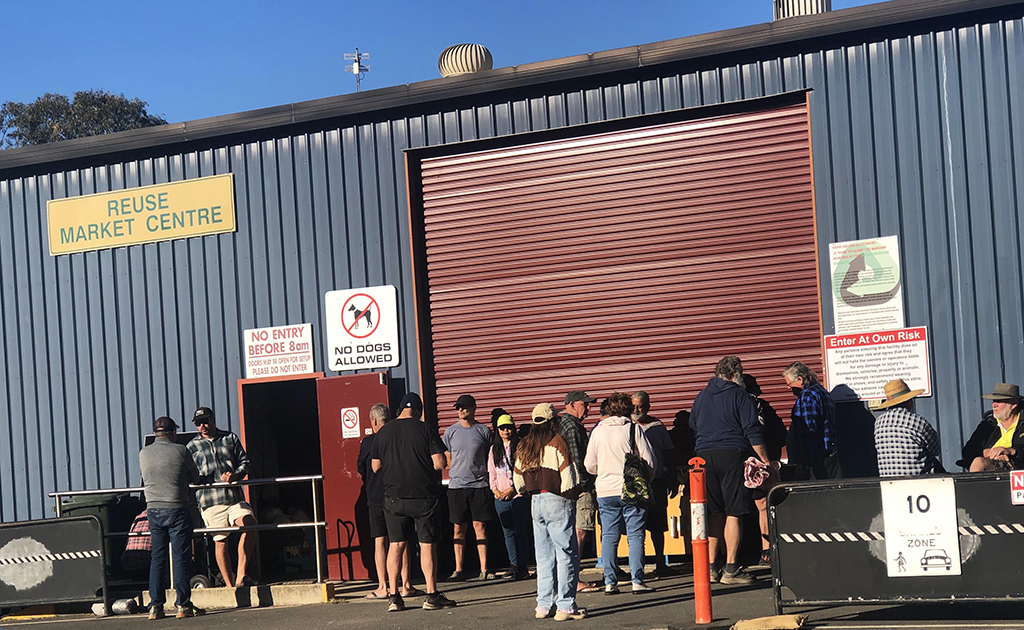
I have recently discovered one of my favourite community spaces in Hervey Bay.
It is not an art gallery, a library or a community centre. It is the local reuse centre at the resource recovery facility.
Since moving back to Hervey Bay, I have been trying to buy secondhand and reused things wherever I can. I have had to furnish an entire house, so I have become a fairly regular visitor to the reuse centre. And squeal, I did score a complete set of Tessa 1980s furniture!
But as much as I have enjoyed finding the occasional treasure, I have started to notice something else happening there. It is a place where people connect.
Quite often, I see the same people coming back. Some of them don’t seem to buy very much at all. They might wander around, have a look, chat with the staff and then start talking with other regulars. People know each other, they share stories about bargains they have found, they ask questions and they help each other find things. There is a real warmth to it.
And I have made connections there too.
It made me think about the way we talk about community connection and the places where we expect it to happen.
We often think about community spaces in very specific ways
When we talk about places that bring communities together, we naturally think about libraries, galleries, museums, community centres, parks and purpose built community facilities. And of course, these places are incredibly important. They are deliberately designed to provide opportunities for people to meet, learn, participate and connect.
But I think there is something really interesting about the places where connection happens without necessarily being the primary purpose of the service.
The reuse centre is a good example.
On paper, it is quite easy to describe what it does. People bring items to the resource recovery facility that they no longer want, and items that are suitable for reuse can be diverted from landfill and made available to someone else. There are obvious environmental benefits to that, and there is also an economic benefit in creating another pathway for goods rather than simply disposing of them.
But there is something else happening there that probably doesn’t appear in the service description.
People are connecting.
Sometimes the service is about much more than the service
I think this is something that is really important when we think about local government services.
We can sometimes put everything into neat categories. This is a waste service. This is an infrastructure project. This is a community service. This is a library. This is an arts and culture program. This is economic development.
But communities don’t experience their local government in quite such neat categories. A person might go to a reuse centre because they want to find an inexpensive piece of furniture and end up having a conversation with someone they see every week. Someone might go to a library to borrow a book and end up joining a program. Someone might go to a local park because their grandchildren want to play and end up talking to another family.
The purpose of the service might be one thing, but the experience of using it can be something completely different. And I think we sometimes underestimate the value of those incidental connections.
There is something particularly lovely about the reuse centre
I have noticed that many of the people I see regularly are older members of our community. For some, I suspect the visit is not really about buying something at all. It is about having somewhere to go, seeing familiar faces, having a chat with the staff, looking around, talking about what has arrived and seeing what bargains might be available.
The staff themselves play a huge role in this. They are incredibly warm, welcoming and kind. They know the regulars and are happy to have a conversation. There is no sense that you need to be there for a particular reason beyond simply being there.
And perhaps that is part of what makes the space work. There is no pressure to participate in a program, no membership and no booking. You don’t have to know anyone when you arrive. You can simply turn up.
Community connection doesn’t always need to be complicated
One of the things I have taken from my visits is that building social connection doesn’t always require a big project. It doesn’t always require a million dollar building, and it doesn’t necessarily require a major community engagement program.
Sometimes it is simply about creating places where people with a shared interest have a reason to come together. In this case, the shared interest might be finding something secondhand, sustainability, saving money, a love of old furniture or simply enjoying the experience of seeing what has arrived that day.
Whatever brings people through the gate, the opportunity for connection is there. And when the people running the service are warm, welcoming and genuinely interested in the people who use it, that opportunity becomes even stronger.
Perhaps we need to look differently at the infrastructure we already have
When we plan services and infrastructure, we often focus very appropriately on the primary purpose. We need a road to move people safely. We need a waste facility to manage waste and recover resources. We need a library to provide access to information, learning and programs. We need community facilities to support community activities.
But perhaps we should also ask what opportunities for connection exist within those services. The value of infrastructure is not always found in its primary function. Sometimes it is found in what happens around it. The conversations, the relationships, the sense of familiarity and the feeling that you belong somewhere. These things can be difficult to measure, but they are incredibly important to the health of a community.
Connection can be hiding in plain sight
I think this is particularly relevant as our regional communities continue to grow. We are going to need new infrastructure, new services and new facilities. But alongside that, perhaps we also need to pay attention to the places where community connection is already happening.
Because sometimes the best community spaces are hiding in plain sight. They might not have beautiful architecture or a clever name. They might not have been designed as a social infrastructure project. They might simply be a place where people have a reason to turn up regularly, where they see familiar faces and where there is an opportunity to talk.
For me, the local reuse centre has become one of those places. I still go because I am looking for secondhand treasures, and I am still hoping there might be another piece of 1980s furniture waiting for me. But now I also go knowing that I might run into someone I know, have a chat, learn about a bargain someone has found or meet someone new.
That is a pretty good community service for a place that, at first glance, is simply there to deal with things people no longer want. Perhaps that is the point. Sometimes the places that bring a community together aren’t the places we design for connection. They are simply the places where people find a reason to connect.