
It’s Not My First Rodeo
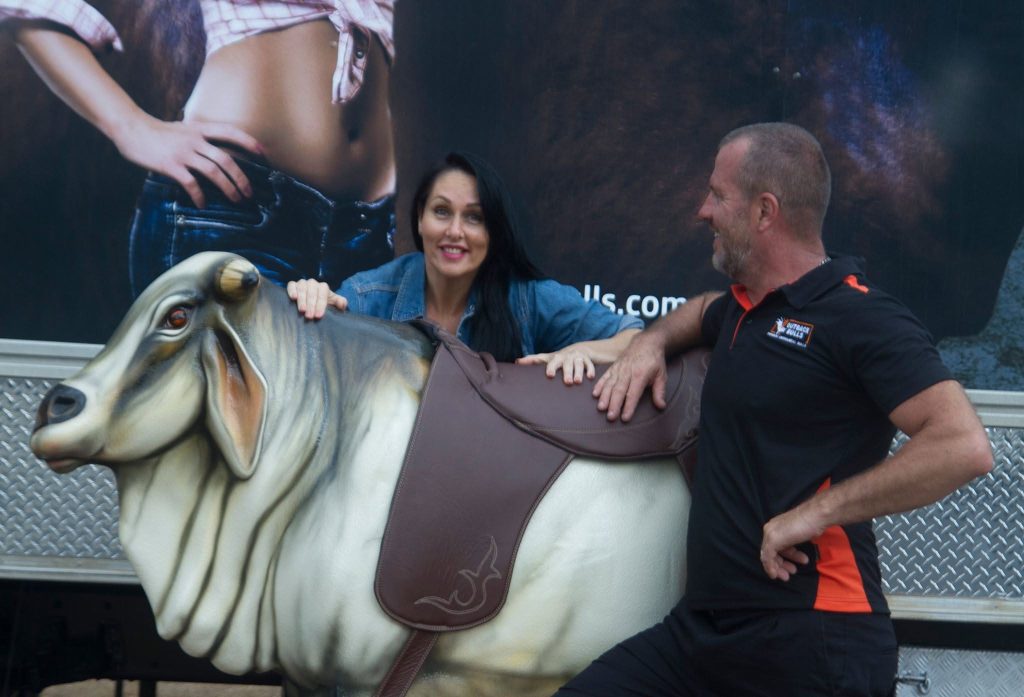
There’s a story behind this photo, and it involves a mechanical bull, a lot of hard work, and one of the more unexpected lessons I’ve learned about regional economic development.
About ten years ago, my husband and I decided to build something a bit different, we wanted to create the only Australian-made mechanical bull, right here in regional Queensland. It sounds like a slightly crazy idea, and honestly, it probably was, but we were determined to see if we could make it work.
We built the business from the ground up, and we were really deliberate about how we did it. Wherever we could, we worked with Australian suppliers, and particularly with businesses here on the Fraser Coast. Motors, components, fabrication, engineering, the development of the bulls themselves. We wanted as much of that supply chain to be local as possible.
That part of the story I’m still really proud of. We weren’t just buying a finished product and selling it on. We were developing something here, working with local businesses to solve problems, build a product, and build capability along the way. Over time the business grew, and we ended up with mechanical bulls operating in pubs and venues right across Australia, including some pretty iconic ones. For a small regional business, that was a huge achievement.
It was also a really practical example of what regional economic development can actually look like, once you stop thinking about it as just “attract a big employer to the region.” A business creates value through the whole network around it , the local fabricator, the engineer, the electrician, the supplier, the designer, the accountant, and everyone else who benefits when that business grows.
Then came the pivot. Our insurance costs went up tenfold, almost overnight. That changed the whole economics of the business. We could have kept going, but the risk and the cost just meant it wasn’t commercially viable anymore. So after building a successful business, with customers all over the country and a genuinely Australian-made product, we made the hard call to walk away.
That experience has stuck with me, and it’s changed the way I think about regional economic development.
We talk a lot about how to encourage people to start businesses in regional communitiess, entrepreneurship, innovation, diversification, investment, local jobs. All of that matters. But I think there’s another question worth asking: what does it actually take for a regional business to survive and scale, once it’s already up and running?
Starting a business is hard anywhere, but regional businesses often carry extra weight, access to skilled labour, supply chains, markets, infrastructure, finance, insurance, professional services. And a lot of the time, those challenges don’t really show up when we look at economic development purely through an investment or jobs lens.
Our mechanical bull business wasn’t just about the revenue we brought in ourselves. It was about the activity we created around us. Every time we engaged a local supplier or a fabricator or a tradesperson, that money went back into the regional economy. Every time we worked through a manufacturing problem locally, we were building knowledge and capability in our own backyard. Every time we sold a bull interstate, we were exporting a product and a bit of regional capability out of our community.
I think that’s the part of regional business that gets underestimated. A small business’s value isn’t really contained in its own turnover or headcount. Its impact runs a lot wider than that. And when a business like that disappears, we don’t just lose a business , we can lose the local supply chains, the skills, the confidence, the capability, and the chance for other businesses to grow alongside it.
To be clear, I’m not saying every business that starts should be shielded from commercial reality. Businesses need to be viable, and risk comes with the territory. And there’s no simple fix for things like insurance costs, regulation, or rising operating expenses. But if we actually want stronger, more diverse regional economies, I think our focus needs to go beyond just attracting new businesses in the first place.
We also need to understand what’s getting in the way of good regional businesses surviving, innovating, and scaling. What are the barriers that push a business , one that’s proven its market, created local economic activity, shown it can grow to eventually say, this just isn’t viable anymore? And what can governments, industry bodies, economic development organisations, and regional communities do differently, so those businesses have a better shot at making it?
A lot of the time, the businesses that most need support aren’t the ones putting their hand out. They’re already doing the hard work, investing their own money, taking the risk, employing people, buying locally, building something that can compete well beyond their region. What they usually need isn’t someone to build the business for them. They need an environment that doesn’t make it unnecessarily hard to keep building it themselves.
Our mechanical bull business didn’t end up being the long-term business we’d hoped for. But I’m still incredibly proud of what we built, the people we worked with, and the fact that we proved you could build something genuinely unique in regional Queensland and sell it right across the country.
And maybe that’s the real lesson here. Regional economic development isn’t only about chasing the next big investment. Sometimes it’s about making sure the businesses that are already here get a fair shot at growing.